
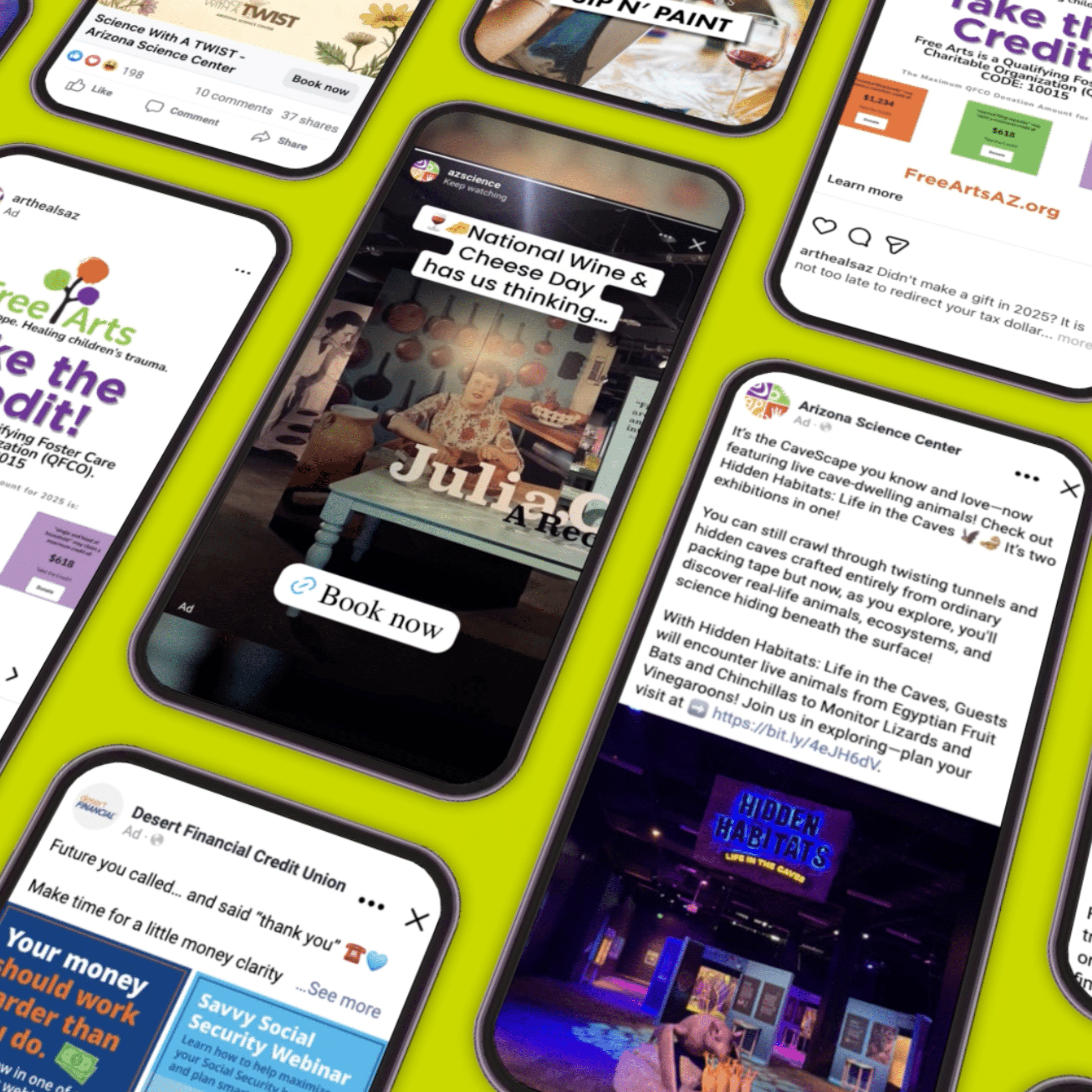
The Great Post Nobody Saw
We’ve all had one. The organic post that nails it. The creative is on brand, the caption is sharp, the client loves it, and your team high-fives in Slack.
Then you check the numbers, and only a small slice of your own followers actually saw it.
If that feels familiar, you’re not imagining things. Sprout Social cites a Demand Curve study showing average organic reach dropped roughly 62% between 2020 and 2023. At the same time, organic content is competing for attention with creators, other brands, and your audience’s friends and family in increasingly crowded feeds.
For a long time, I thought great content would eventually find its audience if we were consistent enough. Over the past year, I’ve changed my mind. Great content still matters. It just needs help getting seen.
That’s where paid social comes in.
What is paid social, and how is it different from organic?
Organic social is anything you post without paying to promote it. Paid social is content you put budget behind, through ads, boosted posts, or paid creator partnerships, to reach a bigger, more targeted audience.
For years, organic and paid social were treated like two separate lanes. Organic built community. Paid drove conversions. But the strongest social strategies today use them together: organic shows you what resonates, and paid helps more of the right people see it.
The benefits of boosted posts
If you’re researching whether boosting posts is worth it, here’s what the research and the platforms’ own tools point to:
- You’re promoting proven content. A post with strong organic engagement has already shown the message works, so you’re not guessing.
- You reach people beyond your followers. Paid social lets you target by interests, behaviors, and demographics instead of relying on the algorithm.
- You get results faster. Organic growth can take months of consistent posting. Paid can start generating visibility almost immediately.
- You get better data. Paid campaigns report reach, clicks, and conversions in real time, plus insight into which creative and audiences perform best.
None of this requires a massive budget. You can start small, see what works, and scale from there.
How to amplify your organic content with paid social
- Audit your top performers. Look at the last 6 to 12 months and pick your best organic posts. Favor evergreen topics over trends.
- Boost before you build. Start with a winner instead of a blank-page ad concept. It’s more efficient, and you already know the message lands.
- Test variations. Try a different hook, format, or call to action, and let the paid data show you what resonates most.
- Retarget the people who engaged. Move them down the funnel with content that matches where they are.
- Keep it cohesive. If your ad looks and sounds nothing like your organic content, you risk losing the trust you built. Your paid content should feel like a natural extension of your brand.
Create content with the boost in mind
This is the shift I’m most excited about. Once paid and organic stop living in separate lanes, it changes how you create content in the first place. If you know a strong post may eventually have paid support behind it, you can build with that possibility in mind from the start: a clear value proposition, a strong hook, and a message that works whether or not the algorithm cooperates.
Attention is the whole game. Mobile Marketing Association research using eye tracking and EEG found people react emotionally to most mobile feed ads in about four-tenths of a second. The first moment has to earn the next one. That changes how we brief creators. Instead of asking for something vaguely “authentic,” ask for something clear, entertaining, and honest about what you’re selling.
People also respond to content that feels like it came from a real person. Sprout Social cites a Stackla study in which 79% of respondents favored user-generated content when making purchasing decisions, compared with 13% for branded content and 8% for influencer posts. Paid social lets you put that human-feeling content in front of a much bigger, more targeted audience.
And the platforms are moving in the same direction. Sensor Tower data reported by eMarketer shows 53% of Instagram ads ran on Reels in Q4 2025, up from 35% a year earlier. Short-form video is where the ad dollars are going.
That also gives creators and influencers a second life. Paid social now includes paid partnerships with creators, so if a creator’s organic reach has dropped, their content can still be a strong paid asset.
Frequently asked questions
- Is boosting a post worth it?
It can be, especially when a post is already performing well organically. Boosting works best as a way to extend content that has proven itself, not to rescue content that hasn’t connected. - What’s the difference between boosting a post and running an ad?
Boosting promotes an existing post with a few clicks. Ads built in the platform’s ad manager give you more control over targeting, placement, objective, and testing. - Do I still need organic social if I’m doing paid?
Yes. Organic builds recognition, community, and trust, and it gives you a testing ground for what resonates. Paid helps scale what works. - How much should I spend on paid social?
It depends on your goals and audience. Many brands start with a small test budget, find what performs, and scale from there.
Where I’ve landed (for now)
I think organic builds the relationship and paid makes sure more of the right people get to be part of it.
Where that balance sits will look different for every client, audience, and campaign. But I no longer expect a great post to carry itself.
If you’ve got content your audience loves, don’t let its organic reach decide how far it gets to go. Give it a bigger stage. Curious which of your posts are ready for one?